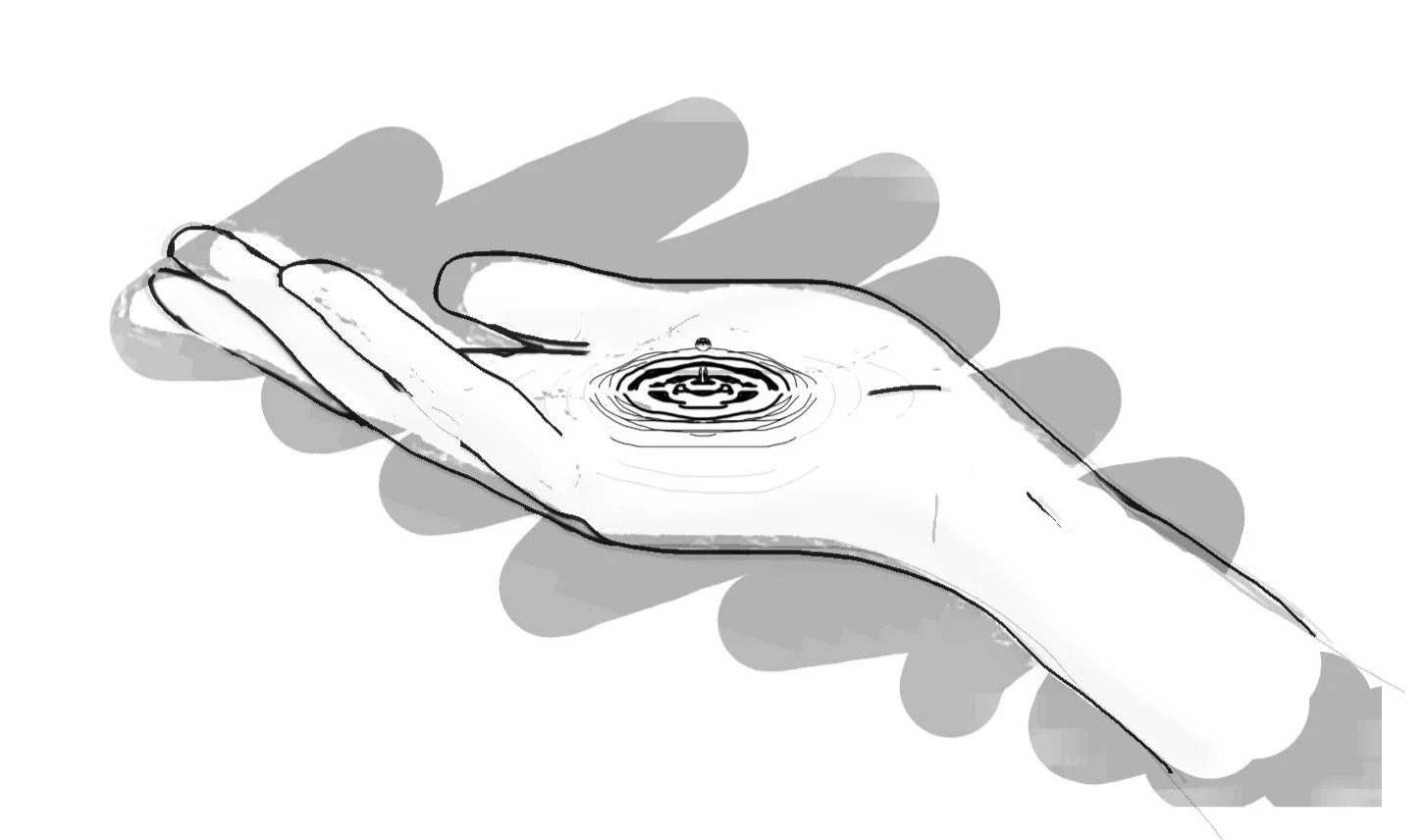
ONE SIZE FITS ALL

It doesn’t rain anymore, not since I died. The weather is always pleasant. Everyone is charming. I try to think on things like money and what I lacked before, but the thoughts always escape me. They are not necessary here.

I suppose no one else likes the rain, but I do. I did. I remember the soft rhythmic rapping of droplets against my window. Consistent. Comforting. Like a blanket.

The nights are too quiet.

I wish it would rain again.

ANAX

THE BLUEBERRY PIE EFFECT

The Blueberry Pie Effect

“This is a very stupid idea,” thought Quack McSplat as he was thrown from the airplane. “A very stupid idea, indeed,” he thought again as he tumbled through the whistling air at a speed he never thought he’d reach.

“Of all the stupid ideas, this is perhaps the stupidest,” he thought one last time before deciding not to think on it anymore out of pure spite. It wasn’t much of a new thought since Quack was a rubber duck and rubber ducks, not having many ideas themselves, tend to think that most ideas are stupid.

Quack McSplat (as he was recently christened) was as surprised as he was annoyed to find himself in his current predicament. He was just a regular bright yellow PVC ducky with a little orange beak and indifferent black eyes (which successfully hid his general peevedness) and there was no particular reason why Quack of all the millions of bath toys made every year should find himself hurtling downwards through the sky towards a raging tornado.

As the stamp on his underside indicated, Quack was first made in a factory in China before being shipped off and stamped with the blue ‘Aquatec’ logo on his front. Along with a few hundred ducks he was distributed as an inexpensive Christmas gift to Aquatec employees at their company headquarters, where he sat for many years on the desk of meteorologist and amateur physicist Kurt L. Hendricks.

Life as a desk tchotchke and occasional squeeze toy wasn’t exactly fulfilling for Quack but what really made the little duck fed up was being forced to listen to the endless stream of very, very stupid ideas that came out of Hendricks’ head. Quack heard all about such nonsense as ‘the butterfly effect’, ‘the junkyard tornado’, ‘Boltzmann brains’, ‘chaos theory’ and ‘self-organisation in thermal convection currents’ and thought little of them.

Hendricks’ favourite and perhaps most stupid musing was a kind of reverse butterfly effect, that if a minuscule ordered event like the wing flap of a butterfly could unpredictably alter a chaotic tornado many miles away, perhaps the reverse could be true, perhaps a great mass of swirling chaos like a tornado could coalesce to create something very small and ordered, like a butterfly.

If everything is made of the same electrons, protons and neutrons, surely it was possible that the wind could rearrange itself to form anything at all? Highly improbable, yes, but still possible.

Hendricks argued this point often with his colleagues who protested that such an idea violated the law of entropy (chaos), but he would point out that the second law of thermodynamics described confined systems, of which a tornado was not one, therefore so long as the entropy of the whole system (the earth) increased then the theory was sound. In other words, if the tornado created chaos elsewhere, it could create order. After all, what is the solar system, the planets, our earth and humans themselves, but a tiny speck of order found in the swirling chaos?

What a stupid idea.

Nevertheless, the Aquatec board ignored Quack’s sage advice and gave the go-ahead for Hendricks to conduct a series of experiments monitoring the nature of tornadoes. The goal was to gather data on the entropy within the storm itself. Any downtick in chaos, any increase in order whatsoever and Hendricks would consider his test a success.

It was when Hendricks was planning the experiment, specifically who would comprise the flight team that he looked to the rubber duck on his desk and the duck stared bitterly back. In a moment of spontaneous playfulness, he snatched up the toy and packed it into his case for the trip. A little in-joke with himself and a nuisance for poor old Quack.

The plane was ready and the equipment was set, all they had to do was wait for a storm then fly above it and disperse the devices; thousands of minuscule instruments able to record numerous variables whilst being buffeted by the tornado itself. These instruments could potentially end up miles from where they had begun and from these recordings, Hendricks could create an accurate model of the storm.

The night before the bad weather, the Aquatec team were holed up in a hotel and one of them remarked after Hendricks’ unfeathered friend.

“Oh, him? He’s just along for the ride,” Hendricks said with a smile before explaining that the inspiration for this experiment came from a story he’d heard about twelve containers of 28,800 bath toys that were washed into the ocean during a storm. The toys floated for years in the water before running aground on beaches all over the world many miles from their starting point, thus allowing for ocean currents to be tracked and modelled in ways that they had never been before. The duck would go first, Hendricks joked, check the coast was clear.

The team rather liked the idea and a name was suggested, ‘Quack McSplat’. Someone grabbed a pen and wrote onto the duck, ‘Live fast, quack young’, which the duck himself thought was rather stupid.

The day of the experiment came. Quack, Hendricks and all the team went up in the plane but before the equipment was dispersed, Quack McSplat was ceremoniously hurled from the plane down into the tempest below.

And so, as Quack hit the storm and thick turbulence threw him about like a rubber duck in a tornado, he thought over all the stupid ideas he’d ever heard and how the stupidest of them all, that something could spontaneously appear in a storm was the one that brought him here. It just didn’t make…

A blueberry pie.

For a brief moment Quack stopped spinning and right in front of him there it was, a steaming hot blueberry pie.

It was quite real; golden crusted pastry latticed over a delicious blueberry filling and it was completely out of place. It seemed to come together from whisps of the wind itself, formed from thin air.

One moment it appeared and then, a fraction of a second later, it disintegrated into nothingness once more.

The recording instruments were still many metres above the storm and so Hendricks would never know that perhaps the most monumentally rare physical phenomenon had just occurred beneath him and the only witness was a plastic rubber duck.

“How stupid,” Quack thought.

ANAX.

HOW TO WRITE A SHORT STORY

“Good writers borrow, great writers steal.” - Herries Anderton

Today marks the two-year anniversary of this site and to celebrate I thought I’d do something a little different. A few people have asked how I come up with ideas for these stories so I thought I’d indulge a little and discuss my creative process here. So:

Where do I get my ideas?

Plagiarism.

Call me a hack, a fraud, call me what you will, but it’s true, every single one of these stories, every word I’ve written is stolen from somewhere else (the web index I copied from an old telephone directory).

Look, I was desperate, OK? I never planned to be a thief, but I was in a rut. I used to believe that magnificence would emerge fully formed in my mind and be beamed straight into readers’ brains, but alas, that dystopia is at least another decade away. No, my work was both sub-par and mediocre. I needed an injection of creativity, some lightning bulb of inspiration. Supposedly ‘inspiration is everywhere’ and ‘you can make a story out of everything’ and yet, whilst, ‘The Many Adventures of Andy the Diabetic Colonoscopy Sack’ is technically a story, it’s also a crap one.

I digress.

I was at a low. Rock bottom, in fact, when I found myself regressing to a childhood habit of staring into TV static. You see, in the rural backwater where I grew up, there was more white noise on telly than actual channels. I became obsessed, just staring at those random floating dots I’d try and see pictures, words, even make up my own stories.

You don’t get tellies like that anymore so I was binging these autogenerated ‘twelve hours of static’ videos online. I’d stare, hoping for that spark, praying to see something in the nothing.

It didn’t work.

Instead, I got into a deep internet hole reading about static and how there’s this fact/myth about old TVs picking up the cosmic microwave background radiation of the big bang, the echoes of the early universe basically. Anyway, twelve dozen hyperlinks later and I’m at the site of this obscure research-project-slash-art-collective that I can’t name or link to obviously because of the lawsuit.

What these guys do is try to ‘decode’ the CMB, which is stupid because it’s radiation, not a message, but they came up with a rudimentary program that turns the noise into this ternary code and then that code into an alphabet and this site just nonstop churns out a meaningless soup of letters. It’s pretty cool to look at (but again, don’t because of the suit). And once again I just found myself staring into the void, but this time…

I saw something.

It was the tiniest of pieces at first, literally only a couple of words at a time, sometimes jumbled up, often in other languages. But I started to string them together, just for my own fun, make up little stories, fill in the gaps.

The key, though, my Rosetta Stone was that god damn piece of crap, freaking ‘Umbrella Baby’. It was this piece of really similar code that kept occurring over and over and I realised that it was the same piece of writing in a bunch of languages. It took ages, but I worked out that the static said, “They found the little fella, sleeping in an old umbrella, he didn’t seem to mind, abandoned yes, but dry.” I still don’t know what the hell that means but the fact that it had an (admittedly amateur) rhyme scheme hinted at some deliberation to it.

Once I’d cracked the code, all these stories just poured out like I’d struck an oil reservoir. Obviously, there were significant gaps and I had to take a lot of creative liberties to make it legible, but they were actual stories.

I read all about the sages, the truthseekers, and the hidden people (Eya, Zoe, Thaddeus, Rico, etc.) who all seemingly never existed. I read about the beginning and the end circling back to meet itself. I read about worlds upon worlds, the fantastical kingdoms of Hirun, the strange mines deep within a planet, and the mundane earths seemingly identical to our own. I read about portraits (that will either drive us mad, let us live forever or just let us dance) and geniis and great conglomerates like FoTA, CSC, and Aquatec controlling it all. And the more I read, the less I could tell whether this was our future or our past or just some elaborate hoax.

[Side note, I’ve still got no idea what in god’s green name ‘The Anax’ actually is, so please don’t ask me.]

So, for the past couple of years now, I’ve been translating this research’s garbage into something readable, then posting it here. There are some two dozen entries now (depending on how you count it), which hopefully a few of you have enjoyed and I greatly appreciate all those who have.

Of course, I never told the researchers about this site and I’m not sure how they found out (ONE OF YOU SNITCHING??) but I reckon I can claim ‘fair use’, considering you can’t copyright the electromagnetic field that literally permeates the entire universe. Unless you can. In which case I’m screwed.

To answer your question, where do I get my ideas from? I stole them. But hey, there’s nothing new under the sun, right? ‘There’s no new ideas only recycled ones’, ‘There’s only six plots’, ‘Shakespeare was a hack and a racist’, ‘First law of thermodynamics: don’t talk about thermodynamics’ and all that. What was I supposed to do, come up with something completely original? Impossible.

My advice? If you’re stuck for ideas, just steal off other people, just change it enough so that they’ll never know. Heck, steal my ideas, I’d love the exposure. Once you’ve got the inspiration (the hard bit) out of the way, then you can just sit back, relax and do the easy part yourself, the execution.

Then, step three, publish!

And that’s how you write a short story. Easy as vomit.